
Review · CITY TOURS
Half day tour – in Sacred city of Anuradhapura Or sacred city of Mihintale.
Ancient stones tell living stories. Travel With Lampa’s half-day tour gives you a focused way to see Anuradhapura’s major Buddhist sites while learning about Sri Lankan history and Buddhism from licensed guide Lampa. I like the clear explanations and the chance to visit eleven important places in one private outing. I also like that snacks and water are included, though the schedule is ambitious and entrance fees are extra.
The tour begins at 8:30 am beside Jaya Sri Maha Bodhi and returns to the same meeting point. You can choose the sacred city of Anuradhapura or ask about Mihintale, but the detailed route supplied here is for Anuradhapura. Lampa’s strong English and storytelling have earned particular praise, yet you should confirm the exact route, transport, and final cost before booking.
In This Review
- Key points to know before you go
- Why Anuradhapura works well as a half-day tour
- Starting with Jaya Sri Maha Bodhi
- Lovamahapaya and Ruwanwelisaya
- Jetavanaramaya and the Abhayagiri monastery area
- Thuparamaya and the Samadhi Buddha
- Isurumuniya Temple and its distinctive setting
- Kuttam Pokuna and ancient water management
- Wessagiriya and the moonstone detail
- How the timing works in real terms
- What Lampa adds to the experience
- Price, transport, and what to budget
- Who should book this Anuradhapura tour?
- Should you book it?
- FAQ
- Where does the tour start?
- What time does the tour begin?
- How long does the experience last?
- Where does the tour end?
- Is this a private tour?
- Are entrance fees included?
- Are snacks and water provided?
- What is the cancellation policy?
Key points to know before you go
- Jaya Sri Maha Bodhi begins the morning: You start at one of Sri Lanka’s most revered Buddhist sites, with about 30 minutes for explanation and viewing.
- Eleven major stops fit into three to four hours: The route covers stupas, monastery ruins, bathing pools, statues, and carved stonework.
- Lampa is the main value: He is a licensed Sri Lankan guide who explains monuments, Buddhism, and national history in English.
- The tour is private: Only your group participates, so the pace and questions are not shaped by a large crowd.
- The $30 price has limits: Snacks and water are included, but admission fees and an air-conditioned vehicle are not.
- Morning timing matters: The 8:30 am start gives you a useful block of sightseeing, but the full stop list leaves little room for lingering.
Why Anuradhapura works well as a half-day tour
Anuradhapura is not one compact monument with a neat entrance and exit. It is a wide sacred city filled with stupas, monastery remains, ponds, statues, and carved architectural details. Without some guidance, it is easy to see impressive ruins without understanding how they fit together.
This is where a private guide helps. Lampa explains the monuments and connects them to Buddhism and Sri Lankan history. That matters at a place like Anuradhapura, where the difference between a relic stupa, a monastery complex, a meditation statue, and a practical water system is not always obvious at first glance.
The route is also broad. You are not spending the whole morning at one famous stupa. Instead, you move through the sacred area and nearby ruins, seeing both major pilgrimage sites and quieter details such as the moonstone at the base of a staircase.
At $30 per person, the value depends on your group size and transport plans. For a private tour with a licensed guide, explanations, snacks, and water, the price is appealing. The important catch is that all fees and taxes are excluded, and an air-conditioned vehicle is not included. Ask before booking how you will move between stops and which admission charges you should budget for.
A few more options to weigh up in Anuradhapura
- Private City Day Tour in Anuradhapura
★ 5.0 · 383 reviews - Minneriya National Park Elephant Jeep Safari Private Tour
★ 5.0 · 68 reviews - Explore & Ride the history of anuradhapura with Vogel Tours
★ 5.0 · 62 reviews
Starting with Jaya Sri Maha Bodhi
The tour starts at Jaya Sri Maha Bodhi in Mahamewna Gardens. Allow roughly 30 minutes here. This is a sacred living Bo tree, a Ficus religiosa, and is described as the closest authentic living link to Gautama Buddha.
That detail gives the first stop a different character from the large stone stupas later in the morning. You are not only looking at ancient architecture. You are visiting a living object with major religious importance, still connected to Buddhist worship in Sri Lanka.
Lampa’s role should be especially useful here. The site carries layers of religious meaning that are not easy to understand from a quick walk around. You can ask about the tree, the gardens, and its place in Sri Lankan Buddhist tradition rather than simply taking photographs and moving on.
The admission ticket is not included. Modest clothing and respectful conduct are sensible at this sacred location, although the supplied tour details do not specify a dress code.
Lovamahapaya and Ruwanwelisaya
Lovamahapaya, also called the Brazen Palace or Lohaprasadaya, is scheduled for about 15 minutes. It lies between Ruwanwelisaya and Sri Mahabodhiya and is remembered as a major building in ancient Anuradhapura.
The short stop suggests that this is mainly an orientation point. You will have time to hear what the palace was and where it fitted into the old capital, but not necessarily time for a long visit. If this building interests you, use the private format to ask Lampa for more context.
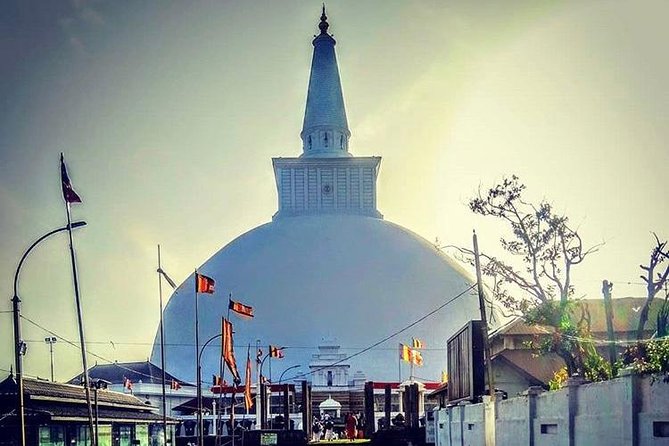
Next comes Ruwanwelisaya, with about 20 minutes. The Ruwanweli Maha Seya is also known as the Mahathupa, or Great Thupa. It is a stupa built to contain Buddhist relics, including a major portion of the Buddha’s relics according to the supplied information.
This is one of the route’s headline monuments. Its scale and religious importance make it a place where a guide’s explanation adds real value. Lampa can help you understand why stupas matter, how relics relate to Buddhist worship, and why this monument holds such a central place in Anuradhapura.
The stop is brief, so you should not expect an unhurried circuit or extended quiet time. The admission ticket is again not included.
Jetavanaramaya and the Abhayagiri monastery area
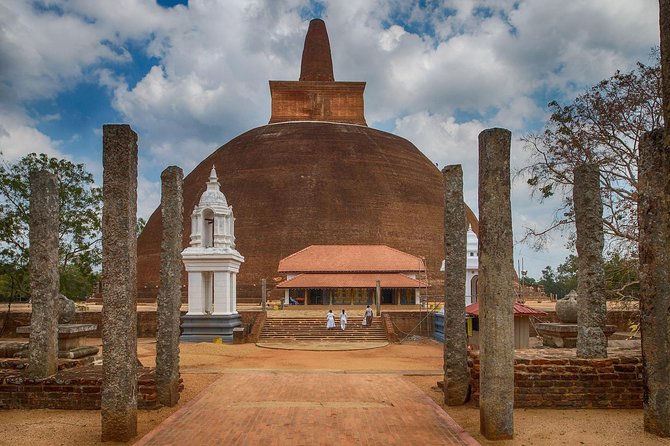
The itinerary gives 30 minutes to a stop labelled Abayagiriya Stupa, with a description of Jetavanarama. It then lists Abhayagiri Dagaba for another 20 minutes. The names are close enough to cause confusion, so I would confirm the exact monuments included when you reserve.
Jetavanarama, or Jetavanaramaya, is a stupa in the ruins of Jetavana monastery and is part of the UNESCO World Heritage area of Anuradhapura. That makes it more than a quick photo stop. It connects a huge reliquary monument with the wider remains of a working monastic centre.
The separate Abhayagiri stop concerns Abhayagiri Vihara, a major monastery site associated with Mahayana, Theravada, and Vajrayana Buddhism. Its ruins cover an extensive area and help show that ancient Sri Lankan Buddhism was not limited to one single tradition or institution.
These two stops are particularly useful for anyone who wants more than the standard sacred-city highlights. You get a sense of the old capital as a network of monasteries and religious centres, not simply a collection of isolated stupas.
Still, the timing is tight. Thirty minutes at one complex and 20 at another can introduce the sites, but the route cannot cover every ruin in detail. If you have a strong interest in archaeology, ask Lampa which site will receive the most attention.
A different kind of day out entirely:
- Minneriya National Park | Private Safari
★ 5.0 · 59 reviews - Wilpattu National park – Morning or Afternoon Safari
★ 4.3 · 57 reviews - Sigiriya Hike & Minneriya Safari Private Full Day Tour
★ 5.0 · 56 reviews - From Anuradhapura: All Inclusive Full Day Safari at Wilpattu
★ 4.4 · 50 reviews
Thuparamaya and the Samadhi Buddha
Thuparamaya receives about 20 minutes. It is described as the first Buddhist temple constructed in Sri Lanka after the arrival of Mahinda Thero, an event known as Mahindagamanaya. Its location in Mahamewna Park gives it an important place in the early Buddhist story of the island.
This is a good stop for historical context. The monument helps connect the arrival of Buddhism with the development of Anuradhapura as a sacred capital. A plain explanation from Lampa can make that sequence easier to follow than a signboard alone.
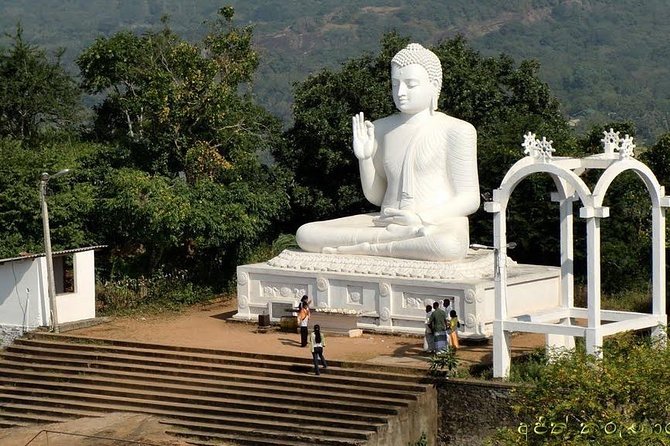
The next stop is the Samadhi Statue, with about 15 minutes. This famous Buddha image shows the figure in Dhyana Mudra, the meditation posture associated with his first meditation.
The short visit is enough to see the statue and hear its basic meaning. You might want to ask Lampa about the posture and how meditation is represented in Buddhist art. Since this stop is brief, it is best approached as a calm pause between larger ruins rather than a long temple visit.
Both locations involve admission fees that are not part of the $30 price.
Isurumuniya Temple and its distinctive setting
Isurumuniya Temple gets about 30 minutes. The ancient site was once known as Meghagiri Vihara or Meygiri Vihara and was built by King Devanampiya Tissa, who ruled from 307 BC to 267 BC.
This is one of the places where the guide’s historical knowledge can help you place the monument in time. The temple is not only an old building. It belongs to the early period of Anuradhapura and helps explain how royal support shaped Buddhist sites.
Thirty minutes gives you more breathing room than the 15-minute visits. You can listen to the explanation, look closely at the setting, and ask questions without feeling quite as rushed.
As with the other stops, the admission ticket is not included. The tour information does not specify the cost of individual entrance tickets, so include that uncertainty in your budget.
Kuttam Pokuna and ancient water management
The Twin Baths, or Kuttam Pokuna, are scheduled for 15 minutes. These two well-preserved bathing pools were built by the Sinhalese during the ancient Anuradhapura Kingdom and form part of the Abhayagiri area.
This stop adds welcome variety. After several stupas and religious monuments, the pools show the practical side of the ancient city. They are a reminder that a major monastery needed water systems, bathing facilities, and careful planning, not only shrines.
The 15-minute allocation is sensible for seeing the pools and hearing their purpose. It is less suitable if you want a long architectural study. Ask Lampa to point out the features that make the pair notable, since the value here is in understanding how the site functioned.
Wessagiriya and the moonstone detail
Wessagiriya, also called Issarasamanarama, is described as an ancient Buddhist forest monastery. It is part of the Anuradhapura ruins and lies about half a mile south of Isurumuniya.
The 20-minute stop offers a different view of monastic life. The word forest monastery suggests a quieter religious setting than the grand stupa precincts. You can ask Lampa how a place like this related to the larger religious centres nearby.
The final listed stop is the moonstone, or Sandakada pahana, with about 20 minutes. This carved semi-circular stone slab is a distinctive feature of Sinhalese architecture. It is usually placed at the bottom of a staircase.
For me, this is exactly the sort of detail that makes a guided visit worthwhile. A moonstone can look like a decorative threshold if nobody explains it. With context, you begin to notice the carving, placement, and architectural role. It is a small object, but it gives you a closer look at craftsmanship after the large scale of the stupas.
How the timing works in real terms
The listed stops add up to nearly four hours before allowing for movement between sites. That makes the advertised three to four hours a best-fit schedule, especially if the route includes all eleven locations.
You should treat this as a highlights tour, not a leisurely archaeological day. The private format helps because your group can ask questions directly and avoid waiting for a large party, but it cannot remove the distance between the monuments.
The 8:30 am start is useful for making the most of the morning. You return to the starting point at Jaya Sri Maha Bodhi, which is practical if you have arranged your own onward plans from there.
Pickup is offered, but the stated meeting point is Jaya Sri Maha Bodhi. The tour information also says the experience is near public transportation. Confirm the pickup arrangement rather than assuming hotel collection is automatic.
What Lampa adds to the experience
The strongest reason to choose this tour is the guide. Lampa holds a Sri Lankan tourist guide licence and explains monuments, Buddhist traditions, and the country’s history.
His English has been praised, along with his ability to tell stories about the city and Buddhism. One detailed experience with him continued for two days, including Anuradhapura and Mihintale, which suggests that you can also discuss a longer plan if a half-day does not feel sufficient.
That does not mean every visitor needs two days. If you have limited time, this route gives you a useful first look. If your main goal is photography, you may prefer fewer stops and longer pauses. If your goal is to understand what you are seeing, Lampa’s explanations are likely the main benefit.
Because this is a private activity, only your group participates. That suits couples, families, and small groups that want to ask questions without holding up strangers. It also makes the tour easier to adapt, although the supplied details do not promise a fully customized itinerary.
Price, transport, and what to budget
The listed price is $30 per person, with five or more bookings recorded in the previous month. For a private three to four-hour guided visit, that is a reasonable starting price, especially with water and snacks included.
You must add the cost of entrance fees. All fees and taxes are excluded, so the final spend will be higher than the advertised rate. An air-conditioned vehicle is also not included, which is important in Sri Lanka’s heat and for a route that covers several separated sites.
Ask three practical questions before paying: Which vehicle, if any, will be used? Are there extra transport charges? Which monument fees will you pay directly? These questions are not complaints about the tour. They simply prevent a low headline price from becoming a surprise at the start.
The activity has a 4.6 rating from 24 reviews and is recommended by 92 percent of participants. Those figures point to a generally strong experience, with Lampa’s English, stories, and explanations receiving the most praise.
Who should book this Anuradhapura tour?
I would choose this experience if you want a private introduction to Anuradhapura and prefer understanding Buddhist sites rather than only photographing them. It suits first-time visitors, small groups, and anyone with a morning free.
It is also a good fit if you want to compare Anuradhapura with Mihintale or discuss adding Mihintale to a longer plan. The detailed route here, however, is Anuradhapura, so confirm your selected sacred city.
I would hesitate if you dislike quick visits, need air-conditioned transport included, or want a slow archaeological study. The route has many stops, and each one receives a fixed time. You may have to choose between seeing more monuments and lingering at the ones you like best.
Free cancellation is available when you cancel at least 24 hours before the start time. Inside that window, refunds are not provided, and changes are not accepted. The tour also requires good weather, with a different date or full refund offered if poor weather causes cancellation.
Should you book it?
Book this tour if Lampa’s interpretation matters more to you than a relaxed pace. His licensed guiding, strong English, and focus on Buddhism give the monuments a clear thread, while the private format keeps the outing personal.
Before booking, confirm the Anuradhapura or Mihintale choice, transport arrangements, entrance costs, and the exact meaning of the Abayagiriya and Jetavanarama stops. If those details suit you, $30 per person is a fair base price for a compact, well-guided morning among Sri Lanka’s most important Buddhist sites.
FAQ
Where does the tour start?
The stated start point is Jaya Sri Maha Bodhi, 89VW+VV5, Anuradhapura, Sri Lanka.
What time does the tour begin?
The tour starts at 8:30 am.
How long does the experience last?
The expected duration is approximately three to four hours.
Where does the tour end?
The activity ends back at the meeting point at Jaya Sri Maha Bodhi.
Is this a private tour?
Yes. Only your group participates in the activity.
Are entrance fees included?
No. All fees and taxes are excluded from the listed price.
Are snacks and water provided?
Yes. Snacks and water are included.
What is the cancellation policy?
You receive a full refund if you cancel at least 24 hours before the experience starts. Cancellations or changes made less than 24 hours before the start time are not refunded or accepted. If poor weather cancels the activity, you are offered another date or a full refund.
Just added in Anuradhapura
- Village tour Sigiriya Rock, Pidurangala Rock and Dambulla temple★ 5.0 · 2 reviews
- Day Tour from dambulla to Sigiriya & Polonnaruwa★ 5.0 · 13 reviews
- Wilpattu Half Day Safari From Anuradhapura★ 5.0 · 4 reviews
- Wilpattu National Park Private Safari★ 4.5 · 2 reviews
- Sunrise or sunset tour pidurangala Rock and Sigiriya Rock★ 5.0 · 4 reviews
- One Day Tour – Sacred city of Anuradhapura & Sacred city of Mihintale. (Sunset)★ 4.5 · 23 reviews
- Wilpattu National Park Entrance Ticket with Private Safari★ 5.0 · 1 review
- Taxi From Anuradhapura to Kandy (Private)★ 5.0 · 1 review
City Tours, compared.
Private Tuk-Tuk City Tour with All Entry Fees
Read our review →
Colombo Tuk Tuk City Tour -Sightseeing Entry Fees & Food Included
Read our review →
Colombo Private Tuk-Tuk City Tour with All Entry Fees Included
Read our review →
Private Tuk-Tuk City Tour with Guide & All Tickets
Read our review →
Browse the lists this tour appears in